Adam-Troy Castro

Writer of Science Fiction, Fantasy, Horror, and Stories About Yams.


The Saga of Mr. Shnodblatt

Posted on June 10th, 2013 by Adam-Troy Castro

So I think I’m gonna take the opportunity to relate another anecdote from my checkered work history. This was not the Job from Hell. This was my time at electronics and appliance superstore Crazy Eddie, which I only imagined to be the Job From Hell at the time, and as I’ve said, there were any number of regular customers whose default position was abuse, as a way to get what they wanted.

I proceed directly to the case of a guy I’ll call Mr. Shnodblatt, who figures in many of these stories. Mr. Shnodblatt took the chain’s “We’ll never be undersold” promise as  a personal challenge. Now, we did have such a promise, and we did honor it, but there were reasonable common-sense limitations. To wit, you couldn’t do what he did several times, come in with an ad reading COMPUTER PRINTER – $50 that didn’t specify the make and model, and angrily demand that we give him the thousand dollar top of the line printer at the same price. But explain this to him, and he started yelling and threatening calls to his lawyer. Nor could you bring in an ad from an outlet that was selling used or refurbished or even display-model merchandise, an ad that said something like UNBOXED DISPLAY MODELS AS IS, and get the same equipment sealed in boxes with full warrantees. You couldn’t. But he would come in yelling. Mr. Shnodblatt called us crooks and liars and pieces of shit so often that we scattered when we saw him coming, and only the slowest salespeople had to wait on him. Not that it even mattered if we were dealing with other customers. Mr. Shnodblatt would interpose himself between those other customers and ourselves, demanding immediate service.

Not to put too fine a point on it: I hated Mr. Shnodblatt. Hated him. Had I the power I would have afflicted him with hemmorhoids, scales, and that parasite that plants itself in a victim’s mouth and replaces his tongue with itself. Mr. Shnodblatt was a nightmare. And one of the worst things he did was show up twenty minutes before closing and behave so obnoxiously in pursuit of the purchase he wanted, even if it was something we could not give him at the price he wanted, that we would still be there half an hour, an hour after the doors were locked, enduring his abuse and finally giving him something well below cost just to get rid of him. He was, in short, an extortionist.

Comes Sunday at 4:15. The store closes at five. It’s a busy day. The nightmare of the day is an ad from some hole of a retail establishment in the city that offers a computer printer at $55.00. Unlike most such ads this one provides the make and model. It is printer from a company that went out of business five years before Crazy Eddie was founded. It doesn’t use ink available in the United States. I repeat this. It doesn’t use ink available in the United States. It doesn’t use paper anybody would ever want to use in business, but thermal sheets available in rolls. We have spent all day telling customers that we have never carried any merchandise by this manufacturer and that the printer is a relic from the stone age and that the ad doesn’t entitle them to take the eight hundred dollar top of the line printer — this being rather early in the age of home computing — from a top manufacturer that is the Ferrari among our merchandise. We have spent all day being yelled at by people who somehow thought this was us changing the rules on them. We have fended most off and actually made sales. But we have reckoned without Mr. Shnodblatt.

Mr. Shnodblatt has this ad and he shoves it in my face and he demands that I give him THAT printer, which we’ll now call the XL-CRAP, or permit him to pick any printer he wants. I start to explain. He starts yelling that I’m a crook. He wants me to know that I’m a con artist, that I’m a piece of shit, that I clearly rape nuns, and that he is NOT LEAVING THE STORE UNTIL HE GETS WHAT HE WANTS. 4:30 passes. 4:35, 4:40. I am stuck with Shnodblatt, who is making a scene that can be heard throughout the store, while my co-worker Ray is driving himself to exhaustion trying to wait on all the customers who are being denied service because Shnodblatt is monopolizing my time.

Another word about Shnodblatt: like most problem customers, his immediate fallback position is “I Demand To See Your Manager!” He is forever demanding to see my manager, always when I cannot give him what he’s asking for at the sale he wants. I have said to him, many times, “Sir, I do not have a manager in charge of just letting you loot the store.” It never matters. He demands to see my manager. I have to abandon my post and get yelled at, later, for once again failing to resolve Mr. Shnodblatt’s mental illness on my own, and bringing the manager into it.

Mr. Shnodblatt demands that I bring the manager. It is 4:45. There has already been an announcement that customers should select their purchases and go to the registers. Shnodblatt is still not budging. He is perfectly willing to do what he has done in the past, keep us at work and away from our own lives until 6 and beyond, in pursuit of impossibilities. The manager, who is irate that I bring him to Mr. Shnodblatt when he has a million and one things to do to wrap up the store, comes over.

The problem is explained. The manager tells Mr. Shnodblatt what I have told him, that Crazy Eddie does not carry the XL-Crap, and has never carried the XL-Crap, because the XL-Crap precedes us, and we are not obligated to sell him any top of the line printer at the same price as the XL-Crap.

After another bellowed characterization of us as crooks and liars and con men and child molesters, Mr. Shnodblatt yells, “I know the way you people work! You promise to beat all prices, but when you see an ad for a price you don’t want to beat, you HIDE AWAY THE MERCHANDISE IN YOUR STOCKROOM AND PRETEND YOU DON’T CARRY IT!”

He says this. Like we clear out the floor space of all our saleable merchandise, every Sunday’s ad.

He demands that we allow him into the stock room, to confirm for himself that there is no XL-Crap there.

He actually demands this.

Now, I don’t know about you, but at this point I would tell him, “Sir, please go patronize another store and never bother us again.” Our manager is a pro. He tells Mr. Shnodblatt that his demand to inspect the storeroom himself is unacceptable for insurance reasons, but that he will, if it’ll solve the problem, order me to search the stockroom, just to confirm that there is no XL-CRAP anywhere on its shelves.

Mr. Shnodblatt actually says that he knows I will only pretend to look and that he will deal with my lying later on, but is willing to go through the motions.

If you handed me a knife at that moment, I would now be serving time.

(And silly as it may seem to you, I am twenty-five years later actually feeling my blood pressure rise as I relate this story. It’s no joke. I take pleasure in the awareness that Shnodblatt is almost certainly dead now. If I knew the location, I’d pee on his grave. If he was alive and alzheimers-ridden and living in an old age home somewhere, I’d get the location and travel there just to slap him in the face. I’m almost serious.)

Anyway. It is 4:50. It has been a long day. I want to go home. I am being forced to undergo a total wild goose chase searching a vast back room for a piece of merchandise that is not there, that has never been there, and CANNOT be there. I am supposed to meet my family for dinner at 6 and I know that I will not make it. I enter the stockroom — whose denizens are all getting ready to leave — and I go to the computer shelves. Anger and frustration drives me to do what I have never done before, climb the shelves, physically climb the shelves, until I’m twenty feet off the ground and dangling over a concrete floor as I rearrange boxes on the top shelf to find what cannot be found.

And whoa! I miraculously ***find an XL-CRAP***.

It is in a crushed box held together with tape, it is covered with dust and has clearly been there for years. A giant hole in the box reveals the printer, with shattered fuselage, a dead roach in the platen, NO included documentation, no power cord, no packing materials, no nothing. It is not a printer anymore. It is industrial shrapnel.

Its presence only makes sense if you posit that some past customer, as loud and as unreasonable as Mr. Shnodblatt, has at some point in the dim past arrived at Crazy Eddie bearing an item that could not have been purchased there, and demanded a refund at such ear-screeching volume that the service department accepted the clearly damaged and badly treated item and presented the refund just to make him go away. (That happened too: irate people demanding refunds for items we could prove they couldn’t have bought from us, and once or twice the people were so impossible the company gave them refunds just to get rid of them. Retail is THAT much a war zone.)

My mind worked furiously. I went to the manager and told him what I had found and what the only possible explanation for my discovery could be. I told him what I intended to do about it.  My manager stuns me by giving his okay.

I return to Mr. Shnodblatt and tell him I have found an XL-CRAP. But —

“A-HA!” He yells “I KNEW IT! YOU PEOPLE —”

“Sir!” I say, speaking over him. “I have had more than enough of your garbage today. If you utter one more insult directed at me and your co-workers you will leave without the item. You will listen to me.”

Crafty, like a pickpocket agreeing to watch your money while you use the restroom, he pipes down.

I explain that we have an XL-CRAP. I explain that it is clearly a return and that it is a damaged box. I explain that if we sell it to him at the demanded price, it will be AS IS, WITHOUT WARRANTY, NO RETURN, NO REFUND, SALE FINAL, and that he will be required to sign an agreement to that effect before he pays.

He agrees.

I write up an order with **all of that*** clearly and gleefully written on the invoice and send him to the register to pay. He has to make his payment and then return to the stockroom to pick up his XL-Crap. He takes the invoice, utters some angry imprecations about how you have to talk yourself blue in the face to get any service around here, and heads off to the register, where he will be the last customer before the store closes.

I go to my co-worker Ray, who is completing some necessary paperwork. “Ray. We have to leave now.”

“In a minute.”

“No. We have to leave NOW. We have to be in our cars and on our way home before Mr. Shnodblatt sees what he’s just bought, or we’ll never get out of here tonight.”

Ray has spent too many hours having his soul sand-blasted by Mr. Shnodblatt. He gets it immediately, and puts his paperwork in a drawer. “I got you. Let’s leave.”

We grab our coats and move quickly toward the exit, knowing that it’s going to be close, because Mr. Shnodblatt is already at the stockroom window, waiting to be handed his XL-CRAP. We punch our time-cards. We turn back at the door and see Mr. Shnodblatt handed his printer in its box. Even from a distance, we can see that he is aghast and dumbfounded.

Just as we exit, we see that it is in his hands for all of one second before the bottom of the box breaks and it plummets to the floor, where it shatters and scatters pieces in every direction.

You know that sound Curly Howard of the Three Stooges made whenever he ran for safety? Whoop-whoop-whoop?

We made it racing for our respective cars.
First Commentary by Adam-Troy Castro

Les Miserables (1934). Directed by Raymond Bernard. Screenplay by Raymond Bernard and Andre Lang, from the novel by Victor Hugo.  Starring Harry Bauer and Charles Vanet. 280 minutes. ****

Les Miserables (1935). Directed by Richard Boleslawski. Screenplay by W.P. Linscomb, from the novel by Victor Hugo. Starring Fredric March, Charles Laughton, and John Carradine.  108 minutes. ***

Other Notable Versions: Too many to list, but we will make special reference to The Fugitive (), based on the American TV series about a wrongfully accused doctor doing good deeds while on the run from a fanatical Lieutenant Gerard; the resonances were very deliberate in the TV show, and ara ceraried over by the movie)

So here’s another slam-dunk against the argument that Remakes Always Suck, occasioning the multi-part, epic return of The Remake Chronicles after a life-mandated absence of several months.

The 1935 version of LES MISERABLES starring Fredric March and Charles Laughton – long considered the “classic” version, though we will take the position that there are several superior ones — was the *eighteenth* screen version of that story. The eighteenth. By 1935. Twelve of those were silent versions. Six were made by 1910. One film inspired by the material was early as 1897. There are over sixty screen versions in all, including multiple Japanese versions, multiple Korean versions, and of course multiple French versions. There are versions in Tamil and in Russian. Versions have been filmed in Egypt, Sri Lanka, Brazil, and Turkey. There are multiple versions filmed in India, using multiple Indian dialects. There’s a claymation version. There are a number of religiously-based versions that contract the entire narrative to the length of a short story and tell us only the memorable parable of the Bishop’s candlesticks, which is a great self-contained short story all by itself. There was an epic five and a half hour silent version, unavailable to us, which was more than an hour longer than the longest of the epic versions we’ll be covering.

LES MISERABLES the novel is a sprawling narrative detailing the travails of one Jean Valjean, tossed into prison for stealing  a loaf of bread and released on parole only to be stalked, for the next twenty years, by a police inspector obsessed with throwing him back into prison. Most people read in abridgement, and it requires further abridgement in any even epic-length film, which is why all versions streamline or omit several storylines completely (including, yes, that four and a half hour version we’re seeing). Some omit the key villains of the novel (yes, even more so than Javert), the larcenous innkeepers / petty criminals known as the  Thenardiers; others simply make them walk-ons.  Some omit Valjean’s years spent hiding on the grounds of a convent in Paris. A few give short shrift to the doomed prostitute Fantine, others to the doomed gamin Eponine, others the doomed street urchin Gavroche (and we can honestly save some time here by throwing up our hands and saying that unless we specify otherwise, the word “doomed” pretty much applies to everybody).  Many ignore the gardener Fauchelevent, who repays a vital favor to Jean Valjean at a key moment.
 
Vital connections are also usually simplified. It is possible to see most versions, including the musical, and not know that the doomed street-urchin Gavroche is Eponine’s brother, or that both are members of the villainous Thenardier clan (albeit ones who seem to have fallen from the tree).  It is possible to see most versions and not know that Marius is sole heir to a vast fortune, currently estranged from his family for political reasons. It is possible to see most versions and not know that Thernadier was once rewarded for presumed bravery at Waterloo.  It is possible to watch most versions and not know how cruel Marius is to Jean Valjean, at one point, banishing the old man from the life of the young girl he raised. It is also easy to miss just how often Valjean escapes Javert by the skin of his teeth. It happens more often than would ever guess; every version ever made has had to omit a couple of close calls and hair’s-breadth escapes, though they don’t all omit the same escapes, or dramatize them in the right order. At least one version we’ll cover deliberately doesn’t even take place in the correct century!

It’s impossible to cover the differences between all of these adaptations without going into some length describing the elements that are emphasized, or omitted, in each, but for now let’s just say that Jean Valjean comes into some serious money shortly after his departure from state custody, and decides to change his identity. He is sitting pretty as the mayor of a town when his old prison nemesis Javert shows up as local police inspector, notes the resemblance to a wanted parole violator, and starts investigating. Valjean finds himself responsible for an impoverished woman named Fantine, who is at death’s door after a desperate existence that has led to sell her hair, her teeth, and her sexual favors; at the moment when Valjean reveals his true identity in order,  to prevent an innocent man from being imprisoned in his name, he finds himself having to flee again to rescue and adopt Fantine’s daughter Cosette.

baur

The Definitive Version: LES MISERABLES (1934)

The 1934 French version, new to us, was made to be shown in three installments, each one the length of the average theatrical feature.

It’s leisurely, and a trial for the attention span and the sore posterior. However, it tells Victor Hugo’s story in far greater detail in any of the other versions we’ve seen. Only in this version do we meet the Thenardiers before Jean Valjean does, and see how deliberately they torment the anguished mother Fantine with demands for more and more money to presumably spend of her child; only here do we see how aware they are that she will soon have to descend to prostitution to afford this, and how little they care. It is also the only version we cover that shows us how, in later years, the Thenardiers stalk Valjean with an eye to extorting more money from him; and the only version with what we can only describe as Valjean’s superhero fight, in which an entire gang led by Thenadier attacks Valjean en masse, and he proves fully capable of handing them all their respective asses.

This version also introduces us to Fantine fairly early – we see her meeting the cad who will impregnate and abandon her – and then shows us the inexorable process which reduces this once vivacious young lady to a dying, toothless hag, dying in winter. It is a horrifying series of scenes. The 2012 musical does show us this part of the story, but gets it out of the way in two songs; this one keeps cutting back and forth between Fantine’s slide downward and the Thenadiers at home squeezing her for more cash, and it is horrifying. (Also, when Anne Hathaway’s Fantine sells her teeth, she sells the teeth in back, that we can’t see. Only one other Fantine of the number we cover is as VISIBLY destroyed, by the time Jean Valjean discovers her predicament, as the one in this film; that’s the one from the Richard Jordan / Anthony Perkins version, and there we only see the after, not the before).

This is one of the only films that introduces us to Marius’s royalist grandfather Gillenormand, here a vainglorious, slightly mad figure as well as snob. It is also the only the only film of the bunch that will tell you that street urchins Gavroche and Eponine are brother and sister, and that Gavroche has essentially divorced his parents (sleeping outside rather than associate with them, though he continues to keep an eye on his sisters).

It is interesting, then, that even here some elisions for dramatic flow are easy to discern.

For instance – as the protagonist of one rather self-reflexive version will someday  memorably note – the story of Les Miserables always seems to stop dead when the young couple, Marius and Cosette, fall in love. They’re a rather dull pair in a narrative overflowing with colorful and interesting characters, and few versions manage to leap the hurdle of their interminable meet-cute-and-courtship, before more entertaining intrigues return to inject energy back into the story. (Frankly, I always thought that Marius is a fool for chasing after the insipid Cosette, when the downright adorable Eponine is not only in close proximity, but in heat.) It’s a marvelous feat of compression that subsequent versions might have done well to heed.

Secondly, most versions omit the period of imprisonment, and escape, that take place between Fantine’s death and Valjean’s visit to the Thenardier’s inn to rescue Cosette; in fact, that’s a rather substantial episode in the book, but in a movie it pretty much sets the story back at square one, at the point where it really does need to be moving forward. Various versions compress this period by having Valjean overpower Javert, or escape quickly while in custody; this version reduces that to a simple delightful image, a jail window with bars twisted like pretzels. Javert wasn’t kidding when he said Valjean was strong!

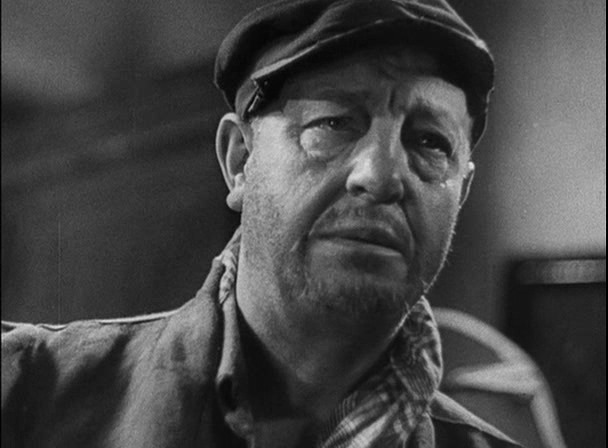
As Javert, Charles Vanel does a pretty credible job doing what every screen Javert seems to do, glower and look constipated – though there’s a nice moment during Fantine’s death scene where he takes off his cap as a show of respect to a dying woman, and in context it’s downright startling. His final conversation is Valjean is also nice, in that he visibly struggles with the difficulty of accepting his old foe as a human being.

Harry Baur is an unusual Valjean in that most movies cast a conventional leading man, and this one casts a rather burly, jowly old man who a) looks persuasively grimy as a convict, and b) is just as persuasive as a well-fed faux-aristocrat either. The long running time gives him the time to play what is likely the most nuanced Valjean, ever.

Charles Dullin’s Thenardier is also the slimiest version of that character I’ve yet seen on film, an evil and malignant little man who actively likes destroying other people as long as he can profit by it. 

All in all? The best version of the novel we’ve seen.

It was followed a year later by the most famous and overpraised version.

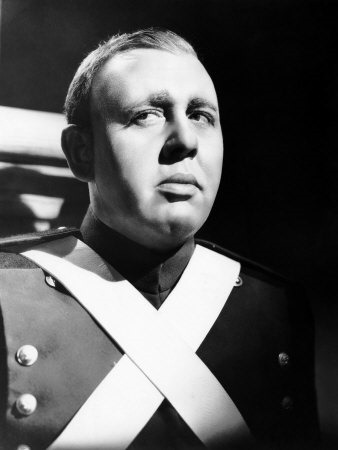
Laughton

 The Compromised Version: LES MISERABLES (1935)

The old-Hollywood version usually praised as the greatest screen version of the tale certainly has a number of strong assets to its credit. Among them are a very fine performance by Fredric March as Valjean and an absolutely blow-the-doors-out-the-back-of-the-theatre ass-kicking version of Javert, assayed by Charles Laughton. Laughton was, of course, that very same year the screen’s definitive Captain Bligh, and his Javert shares much of that character’s DNA: an absolute devotion to regulation, divorced from all compassion even in the face of actual human suffering.

Laughton also gives us an element of Javert that most portrayals miss, much earlier in the tale: a hint of the man’s brittle self-loathing, especially in the scene where he apologizes to “Monsieur Madeleine” for denouncing him. It is all-too-easy, in some versions (notably in the Lewis Milestone film, still coming up), to believe that Javert is so nefarious and bereft of conscience that he arranges the arrest of the wrong man as Valjean, just to force “Monsieur Madeleine” into confessing; it is an interpretation of events that frankly makes no sense, since Javert believes Valjean to be utterly without virtue and has absolutely no reason to believe him genuinely capable of acts of conscience. But many versions either play this confrontation for ambiguity, leaving us to wonder how much Javert really knows…or achieve an unwanted ambiguity by failing to show us what’s really going on in Javert’s heart. Laughton’s performance leaves no doubt. He is wracked with torment over what he perceives as his tragic mistake, and comes so close to breaking because of it that his subsequent renewed hatred for Valjean, once he learns who Madeleine is, makes a terrible psychological sense.

This version also allows him to play up his horror when Valjean releases him at the barricades. This Javert is downright smug when he thinks that Valjean is about to kill him. He is happy. His beliefs have been vindicated. When Valjean subsequently lets him go, he is so shattered that, again, he almost bursts into tears. It is, until the musical, the best screen performance of that moment.

Alas, I must report that Hollywood standards of the era result in unacceptable bowdlerization. The movie is filled with what, to today’s eyes, amount to ridiculous compromises with the material, in order to avoid offending the sensibilities of its audience.

This Fantine does not sell her hair or her teeth and she does not descend into prostitution. Javert wants to arrest her because she bursts in on the mayor without permission. Her subsequent illness is just something that happens, nothing related to her economic status. She’s even well-dressed. There’s absolutely no on-screen evidence that she’s sunken to prostitution. It just doesn’t happen.

We get a glimpse of the Thenardiers, but Valjean does not have to argue with them in order to rescue Cosette. He just finds Cosette in the woods, and any confrontation with her cruel guardians is left to our imagination. He subsequently brings about the reunion of happy Cosette and her mother, a minor moment of closure that is pure stupid invention, utterly weakening the key story point that she dies waiting to see her child again.

The biggest and most offensive bit of story editing comes with the introduction of Marius, who tells us outright that he is “not a revolutionary.” Nope. Now, revolutionaries like Marius may not have been popular in 1935 Hollywood, but making him and his people mere agitators for prison reform, who in fact say that other than that they want MORE law and order – really, he says this! – does outright violence to Hugo’s story, and is downright unacceptable.  You might as well make a new version of REDS where John Reed wants to open up a McDonald’s in Moscow. It is a craven and despicable change. It ‘s worse than a change. It is a lie.

Eponine appears, giving her life to save Marius; it is a brief appearance, and we never learn who her parents are, but she is indeed present. Enjolras is played, in a brief but fiery scene, by the great John Carradine. Very little else occurs to disturb the Valjean Vs. Javert show.

At the end of the film, Valjean bids a heartful farewell to Cosette, but walks less than fifty feet before he discovers Javert’s suicide. The implication is that he will return to Cosette with a shaken, “Never mind.”  In this version, and in many others, there is no doubt that Valjean has been rewarded for all his years of selfless behavior and can now enjoy a happy-ever-after retirement.  (This is not the last movie version that will give that impression.)

It is of course inevitable that any adaptation of a very long and complex book, a third the length of the version released a year before it, will miss or oversimplify some of the elements; but this one does more than that. It downright lies about  many of the more uncompromising threads, softening Marius and bowdlerizing what happens to Fantine over and above the suggestion that once freed of Javert, Valjean will have a happy and unencumbered life.  These are not changes made to streamline. These are changes that substantially damage the story. Charles Laughton’s Javert still needs to be seen. But aside from him this version appears to have become a classic by default – an occurrence that is downright jaw-dropping in view of the wonder that was released, albeit in another language, only one year before it.

Coming Soon 

This rather epic installment will continue, soon, with examinations of the classic story as filmed with Valjeans Michael Rennie, Richard Jordan, Jean-Claude Belmondo, Liam Neeson, and Hugh Jackman! ‘Til then, if you buy bread, get a receipt!

To be Continued!

We Can Remake It For You Wholesale: The Two Versions of TOTAL RECALL

Posted on August 27th, 2012 by Adam-Troy Castro

First Commentary by Adam-Troy Castro

Total Recall (1990). Directed by Paul Verhoeven. Screenplay by Ronald Shusett, Dan O’ Bannon, and Gary Goldman, from a story by Shusett, O’Bannon and Jon Povill, itself based on the story “We Can Remember It For You Wholesale by Philip K. Dick. Starring Arnold Shwarzenegger, Sharon Stone, Ronny Cox, Rachel Ticotin, Michael Ironside. 113 minutes.** 1/2

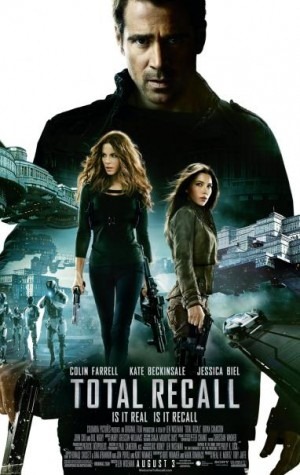
Total Recall (2012). Directed by Len Wiseman. Screenplay by  Kurt Wimmer and Mark Bomback, from the 1990 screenplay and Philip K. Dick story. Starring Colin Farrell, Bryan Cranston, Kate Beckinsale, Jessica Biel, and Bill Nighy. (Produced by an outfit called “Original Film,” which got a huge laugh all by itself at the showing we saw). 121 minutes. ** 1/2

Total_Recall_41-300x475


Okay. Let’s get this much out of the way, first.

The general disdain many people have for the very phenomenon of remakes is often centered on the movie made so perfectly the first time that it is unthinkable to imagine such perceived perfection ever being sullied by an inferior imitation.

And there’s something to be said for this: after all, we have the remake of PSYCHO, a failed attempt to catch lightning in a bottle a second time.

The reflexive disdain is so automatic that it has, in the past, condemned films that had something to go for them. We’ve discussed how one great movie, The Wages Of Fear, was remade as a pretty damn good one, Sorcerer, and how many critics of the time assaulted it just for the unwelcome presumption.

We have seen some rhetoric of the kind directed at the latest big remake to hit the multiplex, a second film called Total Recall.

The implication is that the original was such an unparalleled classic that just to even attempt to remake it was blasphemy.

But let’s be honest here. The original was not a capital-g great movie. Like the remake, it’s a rather dopey one, enjoyably kinetic in its setpieces and resonantly paranoid in its premise, but nevertheless a dopey one, driven by machine-guns and explosions and a McGuffin that fails to pass the bullshit test of anybody with even a passing familiarity with science. The remake is also a rather dopey film, also enjoyably kinetic in its setpieces and resonantly paranoid in its premise, but driven by machine-guns and explosions and…well, the rest of the sentence continues on as before, even though the McGuffin here is entirely different than the one in the original film and therefore requires an entirely different species of bullshit.

The films have many of the same strengths and many of the same flaws. It is possible to consider both absolute crap and it is possible to consider both enjoyable thrill rides. It really depends on how “hard” you prefer your science fiction. In either film, if you require your physics to obey the laws ogf the real world, you might as well not pay the price of admission.

In broad strokes, the setups are identical. Both films open in a near-future metropolis, where a happily-married menial worker named Quaid (Arnold Shwarzenegger in the first film, Colin Farrell in the second), who feels stifled by the same old grind of to-work-and-back, has been having dream-flashbacks of an adventurous life not his own. The dreams come complete with a woman not his wife, which disturbs that wife (Sharon Stone in the first film, Kate Beckinsale in the second), who is remarkably understanding about her man having erotic dreams about someone else.

Still driven by the sense that something in missing, Quaid goes to Rekall, a corporation that sells false memories of grand times the customer has never lived. He is talked into a dream involving himself as an unstoppable secret agent. But midway through the procedure, something seems to go wrong; it seems that he might actually be a secret agent named Hauser, who was only weeks ago mind-wiped and installed in his current life by the forces of a villain named Cohaagen (Ronny Cox in the first film, Bryan Cranston in the second). Now Hauser must flee ruthless assassins who include his own loving wife, while seeking out the answers to the mysteries behind his origins.

The films share a number of other dramatic beats in common, among them the major revelation regarding Hauser’s real agenda. But they are otherwise so different that neither really spoils the other. Let’s take a look at the differences.

The Futures

The key difference is in the science-fictional background.

The 1990 film presents us with a future where Mankind has started to colonize the solar system, where people on Earth live pretty much the same way they do today except with more gadgets and where people on Mars live under the heel of a corrupt local administrator whose pocket-lining ways has created a permanent oppressed underclass of mutants and other 99 percenters. Questions of harmful radiation, of life support, and of the stupidity of firing machine guns around glass in a pressurized environment – which is stupid, but clearly a joke the movie is aware of, given that Michael Ironside’s rather dim manhunter makes or tries to make that same mistake multiple times – all factor into it, but the overall impression given is that mankind’s horizons have expanded and that there are enough wonders to go along, if not for the few selfish and brutal people who insist on ruining it for anybody. It’s hard to imagine minding a life in this future, as long as you’re one of the privileged and all the shooting is safely in the past. It’s all rather familiar, really – it even has many of the same corporations.

Some of the new gadgets are particularly fun; I like the bored airhead receptionist, amusing herself by instantaneously changing the color of her sculpted fingernails. And some have actually entered our lives; i.e., the wall-sized television sets.

The 2012 film, more in line with the tone of author Philip K. Dick, presents us with a firmly Earthbound humanity, on a ruined planet that possesses only two habitable regions, one in what used to be Great Britain and one in what used to be Australia. Both regions, beset by wild overcrowding, have built their urban centers up vertically, in a form of architecture that involves laying one city entirely over another, and then another over that, for as high up as the superstructure will support.  Workers commute from Australia to Great Britain on a daily basis, via a kind of skyscraper commuter train that plummets through the core of the Earth, and somehow builds up enough momentum to make it all the way to the surface on the other side.  So it is, in a very real sense, a world that has lost all hope, and where all the machine gun battles and running around amount to a form of fighting over the crumbs. There are gadgets here, as well – Colin Farrell’s Quaid has a refrigerator that also functions as an I-Pad, and there’s a wondrous chase through a network of crisscrossing high-speed elevators, traveling both vertically and horizontally. But again, the impression given is that one world is a hopeful one, marred by corruption; the other is a terrible place where people can live their lives, but where their horizons are strictly proscribed.

The differences between these two milieus is further underlined by the visual palate. The 1990 world has some dark and/or undeveloped places, but is mostly a brightly-lit and colorful place, where even the sleazy hooker bar looks about as threatening as a McDonald’s at lunch hour. For the most part, the 2012 world is grimy, grungy, dimly-lit, often rainy, and in the Australian scenes populated by people who look like they’ve managed to eke out a few precious square meters for themselves and dress to let us know it. This extends to the look of the false-memory shop, Rekall. In 1990, it has stone walls, but is clearly an upscale business, with techs in white coats, a smiling high-pressure salesman, audio-visual presentations for the slower folks among the clientele. The model is a travel agency. The 2012 version is tucked away in an alley in the midst of a skeevy hooker neighborhood, is dimly lit, and is decorated for mood  – the impression given being that it’s more of a vice-driven enterprise.

(Both places have a three-breasted hooker, but 1990’s three-breasted hooker is implicitly one of the area’s mutants, and the 2012 specimen is a one-of-a-kind anomaly, possibly a new form of deliberate body-mod.)

Claims that the 2012 version is “just” a ripoff of the original are defeated by the change in design. Clearly, a lot of thought went into making the new version look different. The competition between them is frankly a wash. 1990 is brighter, more colorful, larger, more filled with visual humor; 2012 is more eye-popping, more dazzling visually, less hopeful and certainly more a world that anybody would mess with his mind to escape. 


The Performances

1990 star Arnold Shwarzenegger has often been accused of being utterly without acting talent. That is a canard. He is no grand thespian, and was indeed at his best in the first Terminator film where he was employed less as character than as living special effect, but any close examination to his accomplishments on screen reveals than he’s actually pretty good at expressing rage, fear, terror, pain, amusement, amiability, charm, uncertainty – not quite a full spectrum of human emotion, and certainly not enough to completely overcome his easily-parodied line readings, but certainly enough to function within the scenarios usually provided for him. He is a larger than life figure, and viewers never wanted him to be anything other than his usual screen persona, anyway. (Hence the frequent, jocular repetitions of “I’ll be back.”)

2012 star Colin Farrell is an actor of harder-to-deny talents, who has been very good indeed in character-based movies (two capital-g Great ones: The Way Back, In Bruges),  but one odd result of casting him in big-budget action films is that he tends to disappear in them even when he’s supposed to be the focus (see: Miami Vice, Daredevil).   In his Total Recall, he’s very good indeed as a hero who imagined himself an ordinary man and now finds out he’s not (or, in the other interpretation, as an ordinary man who is merely being made to imagine that he’s a hero), but much of his acting is subtle, inward, as far from over-the-top as possible. It’s a better performance, technically, but is it a better one for the material? This reviewer is honestly not sure. Call it a wash.

Bryan Cranston has recently made his bones playing a good guy who becomes a bad guy in Breaking Bad, which is why it’s so disappointing that his 2012 evil mastermind is not nearly as memorable as Ronny Cox’s 1990; he’s just not given the same level of emotion to play. On the other hand, Sharon Stone’s vicious undercover wife from 1990 is just a little bit more than competent and Kate Beckinsale’s equivalent in 2012 is a wonderment; she is an unstoppable force of nature, a frightening figure even when she just frowns with determination, from a distance. It is grand theft movie, first class, by far the best reason to see the remake.

Beckinsale’s character, Lori, is actually the combination of two characters from the 1990 film, Lori and Richter. The loss of Richter (played in 1990 by Michael Ironside) is a major one, in that his character has more than one pressing reason to break orders and want Quaid dead. There’s a great exchange between him and another of Cohaagen’s men, regarding Lori’s undercover role as Quaid’s wife: “Are you saying she enjoyed it?” “No, I’m sure she hated every minute of it.” Ironside played him as a guy who adored his wife but wanted to erase her transgression by any means possible, to the point that it rendered him reckless and stupid. It was a performance that made it possible to feel sorry for him. As great as Beckinsale is in her performance as Lori, a female terminator, it’s a shame that the streamlining of the story deprived us of a subsidiary villain who could have had some equivalent fun with this dynamic. 

The Competing Species of Bullshit

In Total Recall 1990, the big secret is the discovery of a massive alien machine designed to melt a glacier in the core of Mars, and thus provide the planet with a breathable atmosphere.

This is a terrifically cosmic science fictional concept called “terraforming,” and it renders Cohaagen an even greater villain in that he refuses to turn it on, preferring to profit from a Mars where every citizen has to pay for every breath of air. (Oh, he provides some lip-service to fears over whether the machine is safe…but really, it’s clear; he just doesn’t want to destroy the Mars that enriches him.) In the climax, the erupting plumes of vapor shatter all external glass in the colony, but renders Mars a blue-skied paradise within minutes.

Umm. Sorry. The first bad news is that it can’t possibly work that way. Even if that much gas is created, all over Mars, it’s impossible to believe that the air would dissipate all over that globe in mere minutes, unless it creates a worldwide windstorm far stronger than the most violent terrestrial hurricane. And, frankly, just providing Mars with an atmosphere is not the problem. Finding a way for Mars to keep an atmosphere is the problem. There’s a reason why it barely has an atmosphere now; it simply doesn’t have the gravity to retain one. Even if the colonists could enjoy a few minutes of balmy weather in the aftermath of the machine’s activation, the same problem would face them a week or a month or a year later, after all that atmosphere was gone. It’s like giving money to a derelict with holes instead of pockets. He can’t hold on to it, that’s all.

There’s also the issue that Quaid and Melina are exposed to near-vacuum for long minutes as the atmosphere is created, and suffer explosive decompression, complete with eyes popping out of their heads. That they survive, to face a delightful blue sky and a happy ending, without any medical aftereffects, is unlikely in the extreme…but, hey, if we take the position that the entire adventure just survived is Quaid’s psychotic delusion, thanks to the malpractice of Rekall, then it’s fine in that it really doesn’t have to make sense. If it’s not part of Quaid’s real world, it’s dopey. If it’s part of his dream, it’s sneakily brilliant.

One major problem with Total Recall 2012 is that the nonsensical elements are part of Quaid’s waking world. It really is impossible to believe in the Fall, a skyscraper falling through the Earth’s core (and back up again), as the most practical form of mass transit in an nearly uninhabitable world. The physics of it don’t work and logic of it doesn’t work, and beyond that it’s downright ridiculous to posit one transport full of robot soldiers being enough to conquer a teeming city, when we’ve seen that those soldiers can pretty much be taken apart by anybody sufficiently good at martial arts. It can’t be written off as a dream because the same technology exists when Quaid is awake. It’s pretty enough…but fails to beat the common sense test.

Alas, so does the entire justification behind the amnesia storyline in the first place. Assuming you take the interpretation that everything that happens to Quaid is real and not a fantasy implanted at Rekall, it makes perfect retroactive sense, in the 1990 film, for his character to be working undercover with his memory erased. After all, he’s going after a rebel organization run by a telepath. He needs to believe in his own sincerity. There are no telepaths in the 2012 version. Hauser doesn’t have to believe a damn thing; he could accomplish the same thing by just believing real hard. There is no reason to place him in a position where he can run amuck, wholly out of the control of the people who hired him, killing their own men…except to obey the general plot outline that was such a hit in 1990. It doesn’t make sense, not even if you consider Quaid’s adventures a fantasy.

Another element of the 2012 version that makes less sense than the 1990 version: the robotic cops. In 1990, there are none; there’s just a bunch of thugs and a very powerful alien machine with the ability to change the world. 2012 presents us with a bunch of “invincible wimps” – an ultimate weapon killing machine so flawed that it is possible for an unarmed martial artist to take one down. This would not be a serious problem if they were just scenery. But we are made to believe that the plan is for one commuter-car of robot soldiers, to completely exterminate the entire population of the Australian zone. Not based on what we see. I think they’re in for a fight.

The 2012 version is also so fixated on propelling its story that it omits many of 1990’s grace notes. For instance, in 1990, when Quaid and Malena are captured, Cohaagen puts her in a reprogramming chair too, to make her a “respectful” and “obedient” bride for Hauser. It’s just a little terrifying. Not in 2012; she’s simply arrested.

The Action

Both films have wild over-the-top action sequences, with stunning explosions of violence. The ones from 1990 are funnier, and confidently give some of the best bits to people other than the titular hero. For instance, there are precious few moments of junk-movie bliss more transcendent than the moment in that film when the dwarf hooker grabs a machine gun and starts mowing down thugs. She was a bit player, and people still cheered her. It was, I think, the loudest cheer the movie got, which is saying a lot in a film where Arnold Shwarzenegger gets to shoot or beat up dozens of people. The 2012 version is pretty much a four-character show. It’s a loss.

Give the 2012 version credit, though: it has three lengthy action set pieces that outgun and outclass anything in the original film, among them Quaid’s flight through the shadow streets of the Australian zone, a multi-level chase that runs on for miles and takes him through all strata of his society. That’s neat. So’s the hovercar chase, a scene that would have blown my mind, as a youngster. And so’s the wildest innovation of the whole film, an action scene unlike anything I’ve ever seen in any movie, an extended chase through vertical and horizontal elevators that is eye-popping, original, and downright thrilling. It’s great stuff, the main reason the 2012 version receives a grade equal to 1990’s.

The Memory Vault

1990 version: a campy thrill ride, that is science-fictionally richer, and happens to make just a little more sense,  than the 2012 follow-up. The 2012 version: darker and more despairing, better acted albeit (aside from Beckinsale) to lesser effect, and set in a future that makes no sense whatsoever, but with visuals and action sequences better than anything in the original film.

Life circumstances intruding, there will be no Remake Chronicles essay in September. We hope to be back in October, but those “life circumstances” will be continuing well into that month, so it might well be a 60-day break. We shall see you when we see you.

*

And now, the wife remembers it for you wholesale…

Second Commentary by Judi B. Castro

Total Recall (1990). Directed by Paul Verhoeven. Screenplay by Ronald Shusett, Dan O’ Bannon, and Gary Goldman, from a story by Shusett, O’Bannon and Jon Povill, itself based on the story “We Can Remember It For You Wholesale by Philip K. Dick. Starring Arnold Shwarzenegger, Sharon Stone, Ronny Cox, Rachel Ticotin, Michael Ironside. 113 minutes.**

Total Recall (2012). Directed by Len Wiseman. Screenplay by Kurt Wimmer and Mark Bomback, from the 1990 screenplay and Philip K. Dick story. Starring Colin Farrell, Bryan Cranston, Kate Beckinsale, Jessica Biel, and Bill Nighy. (Produced by an outfit called “Original Film,” which got a huge laugh all by itself at the showing we saw). 121 minutes. ** *


One of these two films is better than the other, and its not the one the critics think.

I had fond memories of the 1990 Total Recall.  I mean the images of Mars were amazing and the mutant population was wonderfully varied.  The story had love, hate, war, rebellion, greedy land barons and sympathetic prossies, everything you need for a fun time in the old west right?  Only this wasn’t the old west, it was the future and having bulgy AHNOLD slinging throw away punch lines just doesn’t hold up.

In 1990, I believed a person could survive in a non atmosphere by holding their breath reallllllly long.  Ummm…chalk up one for the gullible.  But guess what?  The filmmakers wanted us to believe not only that, but no permanent damage would occur after  the incident.  Boy, is there egg on my face.

I could go on picking apart the pseudoscience in the original but why bother, its been done ad infinitum by those much better /knowledgeable than I.

Well, to prepare for the remake I decided to read the source material.  Boy, was I ever taken aback.  Where was all this Mars rebellion stuff? This story is all about a guy trying to search for his true identity and then deciding, he really doesn’t like himself too much.  That’s the film that I saw a few weeks ago.  That’s the story that I read.  That’s the reason so few folks liked it in comparison to the first take. 

Colin Farrell plays most of the film as a poor confused sap finding himself involved in things he doesn’t understand or care about.  Audiences don’t like their hunky leading men to play second fiddle to strong capable women. Audiences don’t like plots with more twists than their poor struggling minds can follow. Audiences today want the story spooned up and fed to them so they can run out to get another big gulp and still catch up in one sentence or less.  This is why the majority of folks prefer the first version. You don’t need to think, just cheer on the bruiser.

The remake has an infinitely better cast, better script , special effects and most importantly a set to make any Blade Runner fan drool in envy. 

To compare, Arnold does a quick bit of surgery and recovers pronto, Colin staggers with each bash and bruise.  Sharon Stone as wife in original is a B**ch, but not unstoppable, Kate Beckinsale as wife in remake is a force to reckon with.  Wife two made a more plausible baby sitter for the “dangerous spy/good guy/bad guy/ummm you name it.  Compare Ronny Cox to Bryan Cranston as the money grubbing baddy and it’s a close one.  Cox oozed menace, but couldn’t fight worth a bean.  Cranston oozed menace and proved a bit formidable too. 

So, throw it all into a pot and stir well and you get a tight SF film nearly true to the source material versus one that took the name and a few plot points and then decided to make an action comedy SF film.  You can choose for yourself. I already have.


Copyright © 2011 Adam-Troy Castro Designed by Brandy Hauman